
Focus
The Laboratory of Molecular Imaging (LMI) employs radiomics in a non-invasive manner to investigate changing metabolic phenotypes across disease states. The lab's research portfolio spans melanoma, lymphoma, and metabolic modulation in cancer — reflecting a broad and growing commitment to understanding how disease alters cellular metabolism. A cornerstone of this work is the LMI's pioneering use of advanced MR imaging and spectroscopy protocols, which enable precise monitoring of dynamic metabolic changes during both disease progression and treatment response.
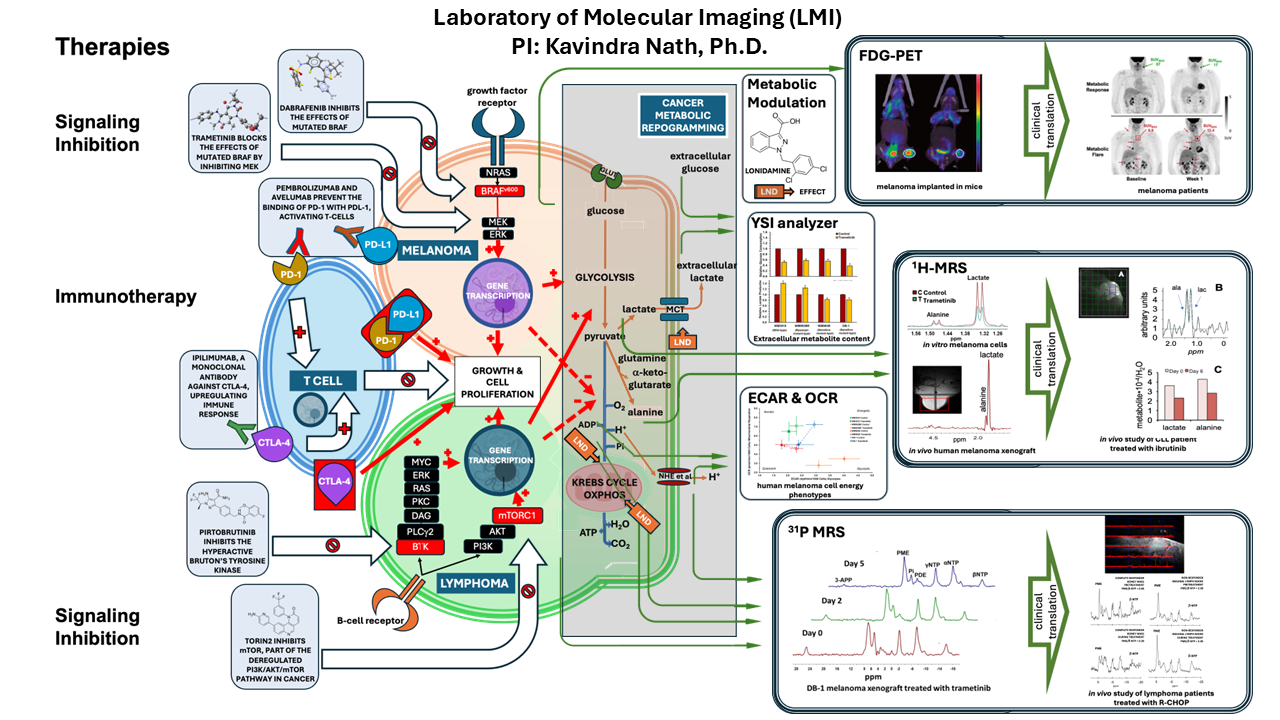
The figure portrays the diversity of programs at the Laboratory of Molecular Imaging, which now encompass research on melanoma, lymphoma, and metabolic modulation in pathological states. The Nath group employs radiomics in a non-invasive manner to query the changing metabolic phenotypes in disease states. Our group has been at the forefront of using advanced MR imaging and spectroscopy protocols. These methods enable the laboratory to effectively monitor the changing metabolomics in disease and treatment. To outline what we do, here is a schematic of melanoma, lymphoma, and a T-cell. We next employ therapeutic interventions both in vitro and in vivo. Typical intermediary metabolism is shown and how this is modified with pathological states. In addition, for both diagnostic and improved therapeutic efficacy, metabolism can be modified by agents like lonidamine that acidify and deenergize the system with specificity. Models are studied to develop analytical protocols preclinically that can eventually be translated to the clinic.
Leadership
Laboratory details
Faculty
Staff
- Pradeep Kumar Gupta, PhD
Research Associate - Mamta Aryabhushan Gupta, PhD
Postdoctoral Researcher - Dinesh Kumar Singh, PhD
Visiting Scientist - David S Nelson
Research Specialist - Stepan Orlovskiy
Medical Student - Gamaliel Isaac, PhD
Programmer - Justin Chae
Medical Student
Students
- Skyler Y Nova
- Meklit Tedla
- Mikal Sanaa Banks
- Aria Eden Osborne
- Adwita Thorat
- Gupta PK, Orlovskiy S, Arias-Mendoza F, Nelson DS, Nath K. 1H and 31P Magnetic Resonance Spectroscopic Metabolomic Imaging: Assessing Mitogen-Activated Protein Kinase Inhibition in Melanoma. Cells. 2024 Jul 19;13(14):1220. doi: 10.3390/cells13141220. PMID: 39056801; PMCID: PMC11274771.
- Nath K, Gupta PK, Basappa J, Wang S, Sen N, Lobello C, Tomar JS, Shestov AA, Orlovskiy S, Arias-Mendoza F, Rauert-Wunderlich H, Nelson DS, Glickson JD, Wasik MA. Impact of therapeutic inhibition of oncogenic cell signaling tyrosine kinase on cell metabolism: in vivo-detectable metabolic biomarkers of inhibition. J Transl Med. 2024 Jul 4;22(1):622. doi: 10.1186/s12967-024-05371-9. PMID: 38965536; PMCID: PMC11225145.
- Orlovskiy S, Gupta PK, Roman J, Arias-Mendoza F, Nelson DS, Koch CJ, Narayan V, Putt ME, Nath K. Lonidamine Induced Selective Acidification and De-Energization of Prostate Cancer Xenografts: Enhanced Tumor Response to Radiation Therapy. Cancers (Basel). 2024 Mar 31;16(7):1384. doi: 10.3390/cancers16071384. PMID: 38611062; PMCID: PMC11010960.
- Gupta PK, Orlovskiy S, Arias-Mendoza F, Nelson DS, Osborne A, Pickup S, Glickson JD, Nath K. Metabolic Imaging Biomarkers of Response to Signaling Inhibition Therapy in Melanoma. Cancers (Basel). 2024 Jan 15;16(2):365. doi: 10.3390/cancers16020365. PMID: 38254853; PMCID: PMC10814512
- Gupta PK, Orlovskiy S, Roman J, Pickup S, Nelson DS, Glickson JD, Nath K. pH-dependent structural characteristics of lonidamine: 1H and 13C NMR study. RSC Adv. 2023 Jul 3;13(29):19813-19816. doi: 10.1039/d3ra01615c. PMID: 37404315; PMCID: PMC10316351.
Email: Kavindra.Nath@pennmedicine.upenn.edu
Phone: 215-746-7386
Fax: 215-573-2113