
Interventional Radiology Residency programs
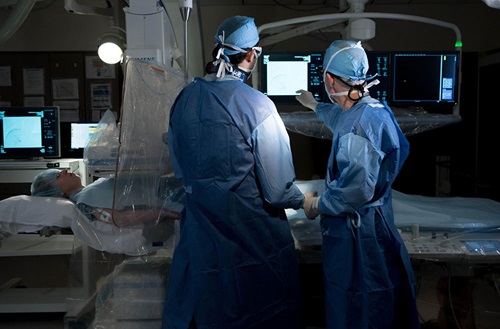
Interventional Radiology Residency at a glance
- Integrated, one-year independent, and two-year independent training pathways
- High-volume academic and community-based clinical experience
- Dedicated IR clinic experience throughout training
- Exposure to adult and pediatric interventional radiology
- Training alongside nationally recognized leaders in interventional radiology
- Strong opportunities in clinical, translational, and outcomes-based research
Integrated Interventional Radiology Residency
A five-year residency that combines Diagnostic Radiology and Interventional Radiology training.
- R1-R3: Diagnostic Radiology training with dedicated IR rotations
- R4-R5: Advanced IR-focused training, including intensive procedural experience, ICU exposure, clinical electives, and research opportunities
- Longitudinal participation in the IR clinic throughout training
- Eligibility for both Interventional Radiology and Diagnostic Radiology board certification upon graduation
Independent Interventional Radiology Residency
Penn offers both one-year and two-year Independent IR residency pathways.
- One-Year Independent IR Residency for trainees who have completed ESIR requirements during Diagnostic Radiology residency
- Two-Year Independent IR Residency for trainees who have not completed ESIR requirements
Both pathways provide comprehensive IR training and prepare graduates for the combined IR/DR certification examination.
State-of-the-art facilities
Penn IR offers access to some of the most advanced procedural facilities in the region.
Hospital of the University of Pennsylvania
- Four fluoroscopy suites
- One CT-fluoroscopy suite
- Two C-arm suites
- Two procedural CT scanners
- Dedicated pre-procedure and recovery areas
Perelman Center for Advanced Medicine
- Two C-arm suites
- Venous ablation suite
- Dedicated IR clinic
- Ultrasound capabilities in all procedural and clinic areas
Additional Penn sites
Penn Presbyterian Medical Center, Pennsylvania Hospital, and the Philadelphia VA Medical Center feature modern IR suites equipped with advanced interventional technology.
Leadership

Additional program details
The IR residency programs offer exposure to a wide variety of patient care experiences. Trainees gain extensive experience and expertise in diagnostic and therapeutic procedures in multiple areas, including:
- Arterial disease — Endoleak embolization, arterial thrombolysis, critical limb ischemia
- Gender-specific health — Uterine artery embolization, pelvic congestion syndrome, fallopian tube recanalization, prostate artery embolization, varicocele embolization
- GI tract — Gastric and jejunal feeding tubes, gastrointestinal hemorrhage
- GU tract — Nephrostomy, ureteral stent placement/removal, complex access for nephrolithiasis
- Lymphatic interventions — Lymphangiography, thoracic duct embolization, liver and abdominal lymphatic embolization
- Liver and biliary tract — Transjugular liver biopsy, transjugular intrahepatic portosystemic shunt, balloon-occluded retrograde transvenous obliteration, portal vein recanalization, percutaneous biliary drainage, biliary stone management
- Oncology — Percutaneous ablation, chemoembolization, radioembolization, portal vein embolization, Denver shunt placement
- Non-oncologic embolotherapy — Pulmonary arteriovenous malformation, vascular malformation, trauma and gastrointestinal bleeding
- Pain management- — Percutaneous sympathectomy, kyphoplasty/vertebroplasty
- Venous disease — Acute DVT thrombolysis, chronic DVT recanalization, IVC filter placement, complex IVC filter removal, superficial venous ablation, microphlebectomy, sclerotherapy
The residency programs consist of daily educational conferences and rounds. Conferences include weekly didactic lectures in IR, IR Chief Rounds (a case-based conference) and liver tumor conference, as well as biweekly dialysis access conference. Conferences covering topics on research, coding and Morbidity and Mortality, are held monthly. Each day residents review the previous day's cases with attendings to learn the technical and clinical considerations important to all cases performed.
Both clinical and laboratory research are performed at the University of Pennsylvania. All residents have the opportunity to participate in research with a mentor, this often leads to residents presenting at the annual Society of Interventional Radiology (SIR) meeting and many others. IR division members speak at several annual Continuing Medical Education (CME) courses, which residents are encouraged to attend.
3400 Spruce Street/1 Silverstein
Philadelphia, PA 19104
Phone: 215-662-3264
Fax: 215-662-2664