Centers and institutes
Many Department faculty participate in both Department-based Centers and interdisciplinary Centers and Institutes across Penn. These programs are designed to advance translational and therapeutic research through collaborations among investigators, academic institutions, industry partners, and funding agencies.
In addition, the Department’s broad faculty expertise is available to support scientific research projects and investigators are encouraged to engage these resources to strengthen and advance their work. More information is available in the Research Resources section.
Penn Medicine Centers and Institutes with significant PLM faculty involvement




Departmental centers
The Center for Neurodegenerative Disease Research (CNDR) is dedicated to defining the molecular, cellular, and systems level mechanisms that drive neurodegeneration and to translating those insights into meaningful therapies. By uniting mechanistic discovery with human disease pathology, CNDR addresses Alzheimer’s disease, Parkinson’s disease, Lewy body dementia, frontotemporal degeneration, ALS/MND, and related age associated disorders. The center’s mission is twofold: to generate fundamental biological insight that reshapes how these diseases are understood, and to accelerate the development of disease modifying and preventive interventions—while training the next generation of scientific innovators.
Founded in 1991 by Virginia M.-Y. Lee, PhD, and John Q. Trojanowski, MD, PhD, CNDR became the first NIH funded Alzheimer’s Disease Core Center in the Delaware Valley and helped establish many of the conceptual foundations of modern neurodegenerative disease research. CNDR has long served as an international nexus for collaborative science, integrating protein biochemistry, cell biology, neuropathology, animal and computational models, and deeply phenotyped clinical cohorts. This vertically integrated approach enables rapid, bidirectional translation between experimental systems and human disease.
In 2026, Edward B. Lee, MD, PhD, was appointed Director of CNDR. His vision builds on CNDR’s legacy while pushing decisively forward: redefining disease boundaries through rigorous pathology driven biology, identifying actionable therapeutic targets, and fostering collaborative, high impact science with the ultimate goal of preventing and curing aging related neurodegenerative disease.
The Cooperative Human Tissue Network (CHTN) is an NIH/NCI funded resource to provide human tissues and fluids from routine procedures to investigators who utilize human biospecimens in their research. Unlike tissue banks, the CHTN works prospectively with each investigator to tailor specimen acquisition and processing to meet their specific project requirements. Through a prospective procurement model, the CHTN satisfies investigator requests with tissue collected specifically for the client’s protocol.
The CHTN's core mission is to serve the public good in fostering biomedical research by collecting and distributing high quality, well-characterized human biospecimens to the scientific community. Since 1987, the CHTN Eastern Division (CHTNED) at Penn has served over 850 researchers who would not otherwise have had access to the tissue that they needed for their work. CHTN provides well-characterized biospecimens to investigators working in the fields of neoplasia, autoimmune disease, degenerative diseases and aging. Research projects include utilization of techniques of molecular biology, immunobiology, proteomics, genomics, and investigations of mutations, nucleic acid chemistry, and microRNA in disease. This research conducted with CHTN specimens has resulted in a growing bibliography of over 3900 publications, 100 patents and 200 patent applications pending.
The CHTNED is administratively managed through the University of Pennsylvania' Department of Pathology and Laboratory Medicine. The CHTNED administrative offices and laboratory are housed in the Hospital of the University of Pennsylvania.
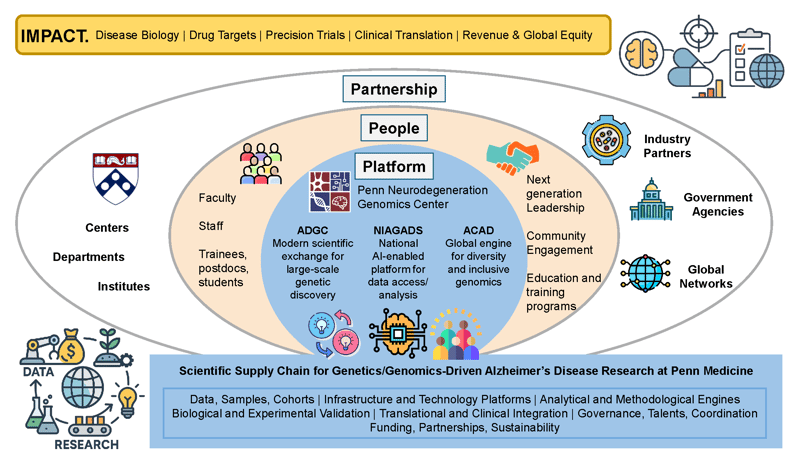
The Penn Neurodegeneration Genomics Center (PNGC), founded in 2016 by Dr. Gerard Schellenberg and Dr. Li-San Wang, is a highly interdisciplinary and collaborative research center focused on the genetics and genomics of neurodegenerative disease. The Center brings together faculty with expertise in dementia, human genetics, genomics, bioinformatics, and biostatistics to advance discovery and accelerate the development of new therapeutic approaches. PNGC is led by Director Dr. Li-San Wang and Associate Directors Drs. Adam Naj, Fanny Leung, and Wan-Ping Lee.
PNGC serves as a national hub for Alzheimer’s disease (AD) genetics research, supporting several major NIH-funded initiatives, including ADGC, ACAD, GCAD, and NIAGADS. These programs drive the Alzheimer’s Disease Sequencing Project (ADSP), a large-scale White House/NIH initiative involving approximately 150 scientists across 19 institutions to sequence the genomes of thousands of individuals. Through these efforts, the Center plays a key role in building research cohorts, coordinating large-scale data analysis, and sharing findings with the broader scientific community.
The Center’s mission is to advance understanding of neurodegeneration through innovative research, collaboration, and training. PNGC leads large, multi-institutional genomics studies; develops new experimental and computational methods; and creates resources that support national and international research efforts. Its integrated infrastructure includes core strengths in information technology, biostatistics, genomics, and education, enabling the management and analysis of large-scale genomic data.
PNGC also fosters a dynamic academic environment by supporting collaboration among faculty across departments and institutions, while providing training opportunities for students, postdoctoral fellows, and staff. Through its research, partnerships, and educational initiatives, the Center is advancing precision medicine approaches and helping to shape the future of neurodegeneration research.