
Center for Personalized Diagnostics
Overview
Penn Medicine's Center for Personalized Diagnostics (CPD) is a clinical genomics laboratory established in 2013 through a collaboration between Penn’s Cancer Center and the Department of Pathology and Laboratory Medicine. The CPD utilizes massively parallel sequencing to analyze variations in genes related to solid and hematologic malignancies, allowing for simultaneous evaluation of multiple genes in a cancer specimen. The CPD aims to uncover genetic mutations within a patient's cancer to facilitate a targeted and personalized "precision" treatment strategy. CPD testing assists the clinical oncology teams at Penn Medicine, by providing information to identify individualized therapies that can dramatically alter a patient's treatment course and outcome.
The laboratory is led by doctoral level faculty with specialty training and board certification in molecular genetic diagnostics and genomics. Expert staff consisting of Genomic Laboratory Technologists, Bioinformatics Scientists, and Genomic Variant Analysts partner with faculty to provide high quality testing for patients. The CPD provides education support to various learners including residents, fellows, and medical laboratory science students by offering rotations and other educational opportunities.
For more information see Guide to Laboratory Services (HUP Test Menu) or contact Penn Labs Client Services Group directly at 800-PENN-LAB.
Highlights
- Precision genomic oncology testing is available for therapeutic decision-making, diagnosis, disease monitoring, and risk assessment.
- PennSeqTM Hematologic Malignancies Panel provides DNA sequence analysis of more than 200 genes associated with hematological malignancies.
- PennSeqTM Solid Tumor Panel provides DNA sequence analysis of more than 200 genes associated with solid tumors.
- Penn Precision Panel provides reflex testing for poor quality and/or low quantity DNA specimens, with targeted sequence analysis of a subset of genes from the larger PennSeq Solid panel.
- Fusion Transcript Panel provides RNA sequence analysis of genes for rearrangements detected in solid tumors. This analysis is partner agnostic, allowing for detection of fusions involving cancer associated genes with a variety of partners.
- Targeted Expedited Molecular Profiling (TEMP) provides targeted, rapid DNA sequence analysis in parallel with RNA sequence analysis to detect specific gene mutations, fusions, and isoforms associated with select solid tumors.
Current CPD gene panels
Sequence analysis of 202 genes
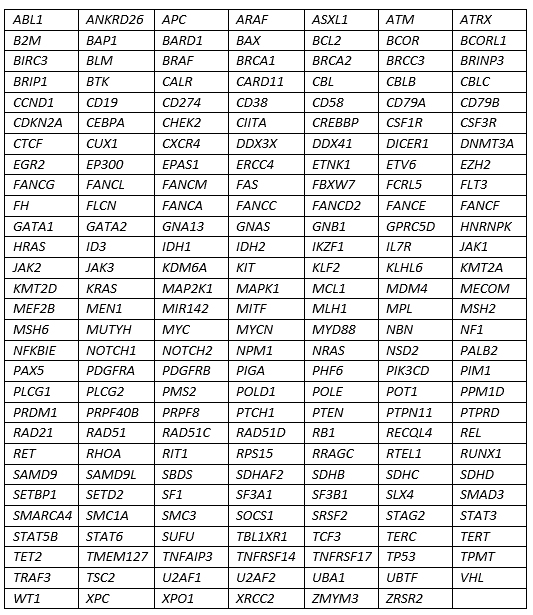
Accepted Specimens: Blood; bone marrow; formalin-fixed, paraffin-embedded (FFPE) tissue; fresh tissue in PreservCyt
Minimum Requirements: 10% tumor nuclei for tissue; 100ng DNA (non-FFPE), 200ng DNA (FFPE)
Covers: Genes listed for the entire coding sequence +/- ~8bp flanking intronic sequence; two hotspots in the TERT promoter; Select Hotspot variants only in U2AF1
Detects: Single nucleotide variants (SNVs); small indels; copy number gains in ABL1, PDGFRA, and MYC
Limitations: Lower limit of reportability 4% variant allele fraction (VAF) [1% for FLT3 ITDs only]. No deep intronic splice variants; no promoter variants outside of TERT; no structural rearrangements; no methylation; no copy number loss
The PennSeq assay enriches for many genomic regions and then is computationally filtered to report variants from a curated set of genes. Incidental variants may be discovered during routine review of the genomic data that fall outside of the curated set of genes. Any Disease-Associated or other potentially significant variant discovered incidentally will be included in the clinical report with a comment and appropriate interpretive text, as needed. By requesting this testing and accepting this report for clinical purpose, implied consent is given that information on incidentally identified genomic variants may be received.
DNA sequencing analysis of single nucleotide variants (SNVs) and insertions/deletions (indels) in 58 genes [18 full coding sequence (CDS) genes; 40 hotspot genes].
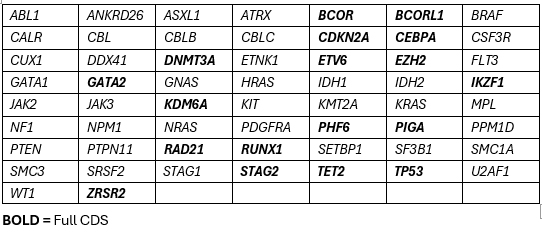
- Accepted Specimens: Blood; bone marrow; bone marrow core in saline
- Minimum Requirements: 20 ng genomic DNA
- Covers: DNA full CDS and hotspots as indicated in the table above
- Detects: SNVs, indels, and FLT3-Internal Tandem Duplications (FLT3-ITDs)
- Limitations: Lower limit of reportability 2% variant allele fractions (VAFs) for SNVs, indels <10bp, and FLT3-ITDS <21bp; 1% VAF for indels ≥10bp; and 0.3% VAF for FLT3-ITDs ≥21bp up to 84bp. FLT3-ITDs > 84bp may not be detected. No structural rearrangements; no methylation; no copy number changes; no tumor mutational burden.
Sequence analysis of 215 genes
| ABL1 | ACVR1 | ANKRD26 | AKT1 | AKT2 | AKT3 | ALK |
| APC | AR | ARAF | ARID1A | ARID2 | ATM | ATRX |
| AURKA | AXIN1 | B2M | BAP1 | BARD1 | BCL2 | BRAF |
| BRCA1 | BRCA2 | BRIP1 | BTK | CCND1 | CCND2 | CCND3 |
| CCNE1 | CDH1 | CDK4 | CDK6 | CDKN2A | CDKN2B | CEBPA |
| CHEK2 | CIC | CREBBP | CRKL | CSF1R | CTNNB1 | DAXX |
| DDR2 | DDX41 | DICER1 | DNMT3A | DPYD | EGFR | EIF1AX |
| ELOC | EP300 | EPAS1 | EPCAM | EPHA3 | ERBB2 | ERBB3 |
| ERBB4 | ERCC2 | ERG | ESR1 | ESR2 | ETV6 | EZH2 |
| FAT1 | FH | FLCN | FOLR1 | FBXW7 | FGF3 | FGFR1 |
| FGFR2 | FGFR3 | FGFR4 | FLT3 | FOXL2 | FUBP1 | GATA2 |
| GATA3 | GNA11 | GNAQ | GNAS | H1-2 | H1-4 | H3-3A |
| H3C2 | H3C3 | HNF1A | HRAS | IDH1 | IDH2 | IGF1R |
| IKZF1 | JAK1 | JAK2 | JAK3 | KDM5A | KDM5C | KDM6A |
| KDR | KEAP1 | KIT | KMT2C | KMT2D | KRAS | LZTR1 |
| MAP2K1 | MAP2K2 | MAP2K4 | MAPK1 | MAPK3 | MAX | MCL1 |
| MDM2 | MDM4 | MED12 | MEN1 | MET | MITF | MLH1 |
| MLH3 | MPL | MRE11 | MSH2 | MSH3 | MSH6 | MTAP |
| MTOR | MUTYH | MYB | MYC | MYCN | NBN | NF1 |
| NF2 | NKX2-1 | NOTCH1 | NOTCH2 | NOTCH3 | NPM1 | NRAS |
| NTRK1 | NTRK2 | NTRK3 | PAK1 | PALB2 | PBRM1 | PDGFRA |
| PDGFRB | PIK3CA | PIK3CB | PIK3R1 | PMS1 | PMS2 | POLD1 |
| POLE | POT1 | PPM1D | PRPF8 | PRKCA | PTCH1 | PTEN |
| PTPN11 | RAB35 | RAC1 | RAD50 | RAD51 | RAD51B | RAD51C |
| RAD51D | RAF1 | RB1 | RET | RHOA | RNF43 | ROS1 |
| RTEL1 | RUNX1 | SAMD9 | SAMD9L | SDHA | SDHAF2 | SDHB |
| SDHC | SDHD | SETD2 | SF3B1 | SLIT2 | SMAD2 | SMAD3 |
| SMAD4 | SMARCA4 | SMARCB1 | SMO | SPOP | SRC | STAG2 |
| STK11 | SUFU | SUZ12 | SYK | TERT | TET2 | TGFBR2 |
| TMEM127 | TP53 | TRAF7 | TSC1 | TSC2 | TSHR | U2AF1 |
| UBA1 | VHL | WT1 | XRCC2 | YAP1 |
- Accepted Specimens: Blood; bone marrow; formalin-fixed, paraffin-embedded (FFPE) tissue; fresh tissue in PreservCyt
- Minimum Requirements: 10% tumor nuclei for tissue; 100ng DNA (non-FFPE), 200ng DNA (FFPE)
- Covers: Genes listed for the entire coding sequence +/- ~8bp flanking intronic sequence; two hotspots in the TERT promoter; Select Hotspot variants only in U2AF1
- Detects: Single nucleotide variants (SNVs); small indels; Targeted copy number gains
- Limitations: Lower limit of reportability 4% variant allele fraction (VAF) [1% for FLT3 ITDs only]. No deep intronic splice variants; no promoter variants outside of TERT; no structural rearrangements; no methylation; no copy number loss
The PennSeq assay enriches for many genomic regions and then is computationally filtered to report variants from a curated set of genes. Incidental variants may be discovered during routine review of the genomic data that fall outside of the curated set of genes. Any Disease-Associated or other potentially significant variant discovered incidentally will be included in the clinical report with a comment and appropriate interpretive text, as needed. By requesting this testing and accepting this report for clinical purpose, implied consent is given that information on incidentally identified genomic variants may be received.
RNA sequencing analysis of 56 genes for rearrangements
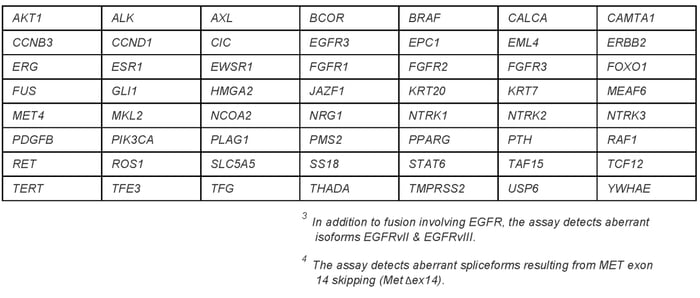
- Accepted Specimens: Formalin-fixed, paraffin-embedded (FFPE) tissue; fresh tissue in PreservCyt
- Minimum Requirements: 10% neoplastic tissue
- Covers: Selected exon-intron boundaries
- Detects: Aberrant transcripts involving the included exons; can detect novel fusion partners at known break-points
- Limitations: Only detects fusions which include at least one of the targets at the included exons; no SNVs; no copy number changes; no small indels; no methylation
Sequence analysis of 59 genes
- Accepted Specimens: Formalin-fixed, paraffin-embedded (FFPE) tissue; fresh tissue in PreservCyt; blood; bone marrow
- Minimum Requirements: 10% neoplastic tissue; 100ng DNA (non-FFPE), 200ng DNA (FFPE)
- Covers: Hotspots and the entire coding sequence of TP53
- Detects: Single nucleotide variants (SNVs); small indels
- Limitations: Lower limit of reportability 4% variant allele fraction; indels unreliable >20bp; no deep intronic splice variants; no structural rearrangements; no copy number variants; no methylation
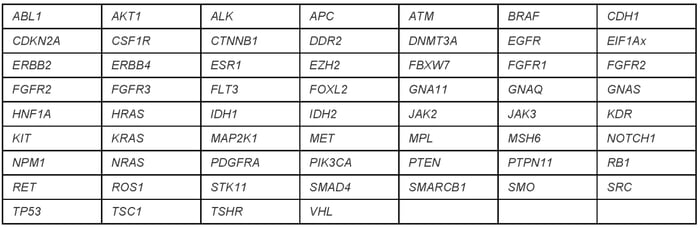
DNA sequence analysis of single nucleotide variant (SNV) and insertion/deletion (indel) hotspots in 45 genes. RNA sequence analysis of 13 fusion drivers and 2 oncogenic isoforms.
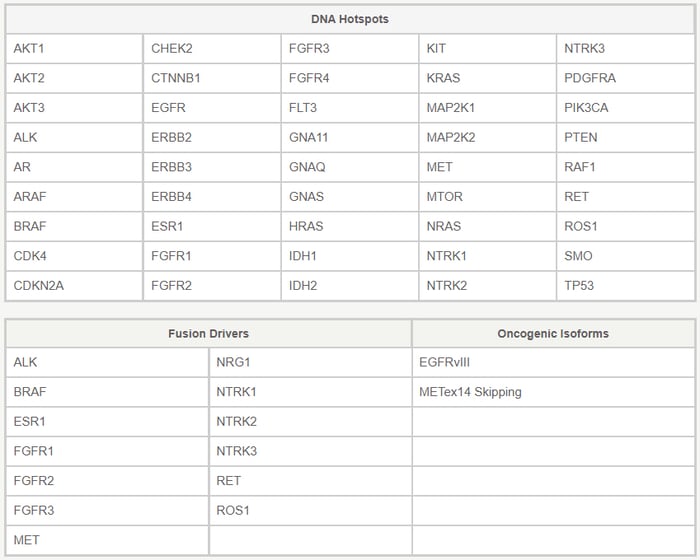
- Accepted Specimens: Formalin-fixed paraffin-embedded (FFPE) tissue, cytology samples, FNA rinses, pleural effusion/fluid, and fresh tissue
- Minimum Requirements: 10% neoplastic tissue
- Covers: DNA hotspots and selected fusions and oncogenic isoforms in the genes listed above
- Detects: SNVs, small indels, targeted fusions and oncogenic isoforms with known breakpoints and non-targeted fusions with unknown breakpoints
- Limitations: Only detects known hotspot SNV and indel variants and known fusions/oncogenic isoforms; lower limit of reportability of 2.5% variant allele fraction (VAF) for SNVs, 2.0% VAF for indels; no methylation; no copy number changes
Contact
Jennifer J.D. Morrissette, PhD. FACMG
Director, Center for Personalized Diagnostics
JeMorris@pennmedicine.upenn.edu
David Lieberman, MS, CGC, FACHE
Associate Administrative Director
David.Lieberman@pennmedicine.upenn.edu
Center for Personalized Diagnostics Laboratory
Tel: 215-615-3966
Fax: 1-215-898-9817