
Advancing Trauma Transfusion Through Whole Blood Research
June 15, 2026
The Blood Bank at Penn Presbyterian Medical Center (PPMC) plays a vital role in advancing trauma care through its participation in whole blood research, specifically the TROOP study (Transfusion Resuscitation with Low-Titer Group O Whole Blood or Products). As a high-volume Level 1 Trauma Center, PPMC manages critically injured patients who often require rapid, large-volume transfusion, making it an ideal setting to evaluate and refine transfusion strategies.
The TROOP study is a multi-year, multi-center clinical trial supported by the Department of Defense and conducted across leading academic medical centers in the United States. Its primary aim is to evaluate the safety and effectiveness of low-titer Group O whole blood compared to traditional component therapy in trauma resuscitation. Whole Blood offers a more streamlined and physiologic approach by delivering red blood cells, plasma, and platelets in a single product, with the potential to improve efficiency, reduce time to transfusion, and enhance patient outcomes in critical settings. The TROOP trial began in 2022 and was subsequently rolled out across participating trauma centers, with site activation occurring during the 2023–2024 timeframe.
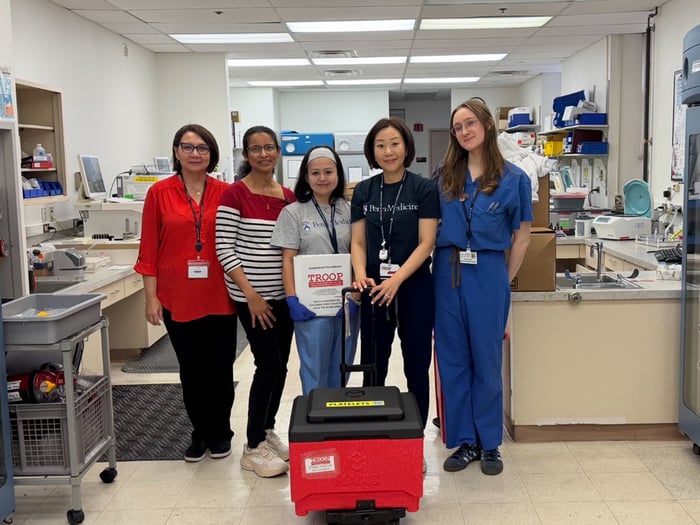
At PPMC, this work is carried out through close collaboration with the Penn Acute Research Collaboration (PARC) team, led by Trauma Principal Investigator Dr. Jeremy Cannon. Dr. Anna Moran serves as the Blood Bank Principal Investigator for the Penn site, helping ensure alignment between clinical research and transfusion medicine practices. Blood Bank Manager Francis Rose Mateo provides operational oversight for the study, managing its day-to-day implementation and ensuring that the workflows required for successful execution are maintained consistently and efficiently.
The Blood Bank team plays a direct and critical role in executing the TROOP study. This includes supporting randomization of eligible trauma patients during Massive Transfusion Protocol (MTP) activations and ensuring rapid preparation and delivery of the first TROOP cooler without delaying patient care. The team also manages study-specific coolers and maintains inventory of low-titer Group O whole blood, balancing availability with expiration risk in a high-demand environment.
This coordinated effort reflects a strong focus on regulatory compliance, patient safety, and the integration of clinical research into emergency care. As the study approaches completion, it has provided valuable operational experience with whole blood in trauma resuscitation. While whole blood is already actively used in trauma cases at PPMC, current efforts are focused on expanding and standardizing its use across all trauma-related Massive Transfusion Protocol (MTP) activations as appropriate. Final decisions will be guided by forthcoming TROOP study results.
Through its participation in the TROOP study, the PPMC Blood Bank demonstrates a continued commitment to advancing transfusion medicine, supporting innovative clinical research, and improving outcomes for trauma patients.