
Dear Applicants,
Welcome to the Penn Internal Medicine Residency Program! It is an incredible privilege to serve as Program Director of a program and community that I care so deeply about. Now in my third year in this role, I continue to be inspired by our residents. They are intellectually curious, committed to their patients and one another, and driven to make medicine and each other better. I am extraordinarily proud of what we have built together, and even more excited about where we are going.
At Penn, our mission is to train compassionate and skilled leaders in healthcare. That mission is grounded in a rigorous clinical training experience that spans the extraordinary breadth of internal medicine, but it extends far beyond clinical excellence alone. We strive to create a collaborative and supportive environment where residents are challenged to think deeply, ask difficult questions, pursue excellence in patient care, and continually grow. We want our graduates not simply to succeed in the medicine of today, but to help shape the medicine of tomorrow.
That commitment to growth and innovation is central to who we are. Over the past several years, we have continued to reimagine how residency training can prepare physicians for an increasingly complex and rapidly changing healthcare environment. We launched our Urban Health Equity Track, creating new opportunities for residents to partner with our Philadelphia communities while developing the skills to understand and address inequities in health and healthcare. We developed a Research Hub to make scholarship more accessible, collaborative, and connected to mentorship across Penn's remarkable academic community. We have expanded our leadership curriculum, strengthened mentoring and coaching, and deepened our community engagement efforts, all while continuing to innovate across our clinical and educational experiences.
These initiatives matter, but what makes this program truly special is the community behind them.
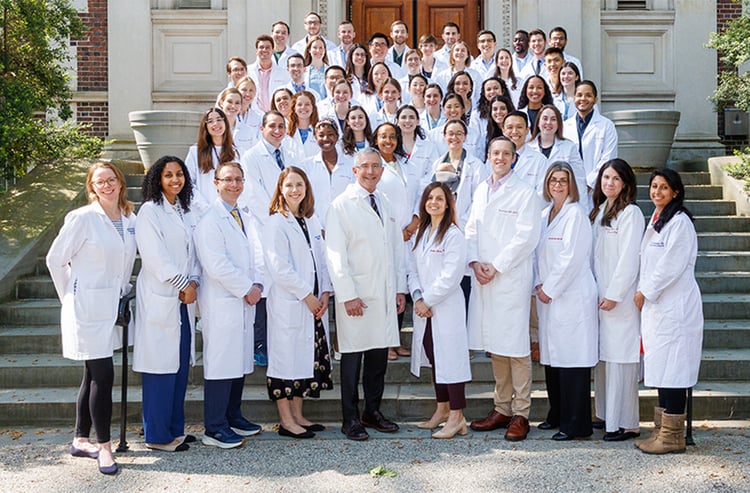
Our residents bring an extraordinary diversity of backgrounds, experiences, interests, and perspectives to Penn. They are outstanding physicians and scholars, but they are also teachers, mentors, advocates, innovators, teammates, and family, our Penn IM Family! They challenge our program to improve, support one another through the demanding moments of residency, celebrate each other's successes, and bring tremendous energy and purpose to the important work we do every day. Their ideas continually shape the evolution of our program, and working alongside them is one of the greatest privileges of my career.
Our faculty share that same commitment. Across our clinical sites and throughout the broader Penn community, residents learn from exceptional clinicians, scientists, educators, and mentors who are deeply invested in their development. Together, we foster a culture that values intellectual curiosity, leadership, excellence in patient care, diversity, collaboration, community engagement, adaptability, and a willingness to innovate and grow.
Those values also reflect something fundamental about how we think about residency education: a great training program should never be finished. Medicine changes. Our communities change. Our learners change. We therefore have an obligation to continually examine how we train our residents, preserve what is exceptional, challenge what can be better, and create new opportunities for our residents to thrive. Innovation at Penn is a commitment to building better ways to learn, to care for patients, and to prepare each of you for the careers and challenges ahead.
My own career at Penn has been shaped by those same principles. I am a proud Philadelphian, general internist, and medical educator. I joined the Penn faculty in 2015 and continue to care for patients and teach residents in the Edward S. Cooper Internal Medicine practice and on the inpatient teaching services at Penn Presbyterian Medical Center. My academic work focuses on medical education, quality improvement, health equity, and educational innovation, and I remain deeply committed to working alongside our residents and community partners to improve the care we provide.
Our goal is both ambitious and simple: to help every resident who trains at Penn become an exceptional physician and develop the skills, confidence, curiosity, and sense of purpose to lead wherever their career takes them. For some, that will mean advancing biomedical discovery, for others, transforming clinical care, educating the next generation, improving health systems, partnering with communities, or developing entirely new ways of practicing medicine. There is no single definition of leadership and we want our residents to have the mentorship, opportunities, and flexibility to discover their own.
If you join us at Penn, you will enter a program with an extraordinary history and tremendous clinical and academic strength. But you will also join a program that is still evolving and a community in which your ideas and aspirations will help shape what comes next.
I am incredibly proud of our residents, our faculty, and the community we have created together. Thank you for taking the time to learn more about Penn Internal Medicine. We look forward to sharing our program, our city, and our community with you throughout the recruitment season.
Warmly,
Amber Bird, MD
Program Director
Internal Medicine Residency Program
The Residency training program in the Department of Medicine enables residents to acquire the foundational knowledge and skills that prepare them for the practice of general internal medicine and its subspecialties through inpatient rotations in general medicine and subspecialty services, outpatient continuity practice, geriatrics, emergency medicine, and a wide variety of elective experiences.
Goals
Candidates seeking training in our categorical internal medicine program should be those who seek…
- To achieve excellence in the care of diverse patient populations, including hospitalized patients in three unique inpatient settings, and ambulatory patients across our outpatient practice sites;
- To gain a comprehensive exposure to medical subspecialties through rotations in intensive care medicine, inpatient subspecialty services, and outpatient subspecialty experiences;
- To acquire and polish foundational teaching skills through both practical opportunities teaching students and fellow house staff and through learning best practices in medical education;
- To enhance research skills through the performance of mentored research projects, and have the opportunity to present successful projects in regional and national conferences;
- To understand and be able to implement key concepts in quality and safety;
- To recognize and mitigate bias and disparities in healthcare, both in the delivery of healthcare to our patients and our communities;
- To promote and preserve personal wellness through participation in small and large group curricula and supported activities, and through a longitudinal curriculum designed to strengthen personal resilience.
Structure: 6+2 block scheduling system
All housestaff participate in the 6+2 block schedule, in which they spend up to six consecutive weeks on inpatient services or electives, followed by two weeks in the ambulatory setting. This system is designed to introduce regular, predictable breaks from the more intense inpatient rotations, while also allowing separation of inpatient and outpatient responsibilities to allow each skill set to develop with an appropriate focus. It also creates four distinct cohorts within each class that facilitate mentoring and social activity scheduling. Within the “6”, each resident gets elective time to dedicate to skill building of their choosing:
Interns – 4 weeks of elective
PGY 2’s – 10 weeks of elective
PGY 3’s – 12 weeks of elective
Average breakdown of rotations
| Rotation | PGY1 | PGY2 | PGY3 |
|---|---|---|---|
| Ward – Gen Med/Specialty | 18 weeks | 12 weeks | 12 weeks |
| Cardiology |
3 weeks | 5 weeks | 2 weeks |
| Oncology |
3 weeks | 2 weeks | 2 weeks |
| MICU |
4 weeks | 4 weeks | 4 weeks |
| Emergency Medicine | 2 weeks | 0 weeks |
0 weeks |
| Ambulatory or Elective | 16 weeks | 22 weeks | 22 weeks |
| Service Block/Jeopardy |
2 weeks | 2 weeks | 2 weeks |
| Vacation | 4 weeks | 4 weeks | 4 weeks |