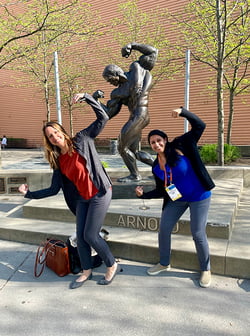
Please follow up on Instagram: @PennIMRes
Life in Philadelphia
How does the cost of living in Philadelphia compare to other larger cities?
Philadelphia is very affordable. The cost of living is 86% higher in New York, 44% higher in San Francisco and 20% higher in Boston.
What about transportation to and from work?
The hospital provides at least partial financial assistance for parking or commuter passes for all house staff. Philadelphia’s public transportation system provides reliable, easy-to-access transportation all around the city, and makes getting to work easy. If parking is desired, the value of the commuter pass is applied to the cost of parking. Those rotating at PPMC can park on-site if they choose the parking option.
What is there to do outside of work?
Philadelphia is a multi-cultural city with something for everyone. There are museums, parks, theaters, a renowned orchestra, a passionate sports community, the waterfront and much more. Many of these activities are within easy walking/biking distance of our hospital and the areas where house staff live. Philadelphia also has a wide variety of restaurants for every budget, with several nationally acclaimed five star delights. Check out the Philly Fun Guide or Discover Philadelphia for more information.
How do the house staff get to know each other?
Through social connection both at work and after work! There are frequent team meals (paid for by the program), happy hours and other special events each month. Although ours is a larger program, it is also a very close-knit program where a sense of family and community is central to the experience.
Things to do
Among our residents' favorite things to do: going out to eat - particularly Sunday brunch, catching a show at the Kimmel Center for the Performing Arts, a trip to the Philadelphia Art Museum, going to a Phillies/Flyers/Eagles game, or simply a bike ride along the Schuylkill River.
- GoPhila.com
- Philly Fun Guide
- Philly 101: The Essential Guide To Philadelphia
- Avenue of the Arts
- Uwishunu-The Insider’s Guide to Greater Philadelphia
Housing, affordability, and where to live
Philadelphia is a city of neighborhoods - most of our residents live in the Center City district (Fitler Square, Rittenhouse, Old City, and Graduate Hospital neighborhoods), as well as University City.
Transportation & travel
Philadelphia is ideally located between Boston, New York, and Washington DC, and is an easy train/bus/car ride to these and other cities. Transportation within Philadelphia is also easy, and many of our residents use public transportation for their daily commutes.
- SEPTA - Public Transportation Within Philadelphia
- Amtrak
- Philadelphia International Airport (PHL)
- Philly Car Share
- Zip Car
- Bolt Bus to NY
Program wide events
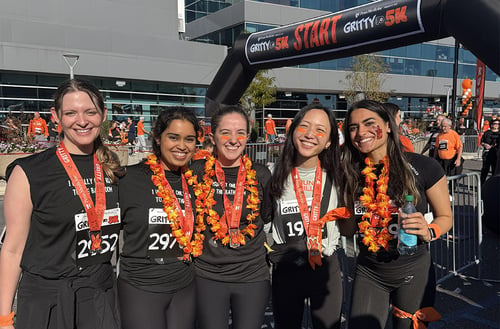
Throughout the academic year, our program hosts a variety of class-specific and program-wide wellness events that bring residents together to celebrate accomplishments and key milestones in their training.
From the very start, interns enjoy one of our most anticipated traditions: Intern Retreat. Coverage is arranged so the entire intern class can spend the day together offsite, focusing on bonding, reflection, and fun. Before the retreat, interns kick things off with a night out as a class, also covered by the program, setting the tone for strong friendships and teamwork that last throughout residency.
As the year unfolds, residents can look forward to several program-sponsored Happy Hours, where they can relax with leadership and core faculty while exploring Philadelphia’s incredible food scene. These gatherings are a favorite way to unwind, connect, and recharge outside of the hospital.
A highlight of the winter season is our program-wide Holiday Party, a long-standing tradition where residents from all classes are provided coverage to enjoy a festive and elegant evening together. As residents reach their final year, we celebrate their accomplishments with SAR Dinners and the capstone event of the year: Program Graduation, where we honor our graduating class and the legacy they leave behind.
At the Penn Internal Medicine Residency, we believe in working hard and celebrating together. From retreats and dinners to happy hours and holiday gatherings, our wellness events throughout the year create a vibrant, supportive community that thrives both inside and outside the hospital.
Wellness
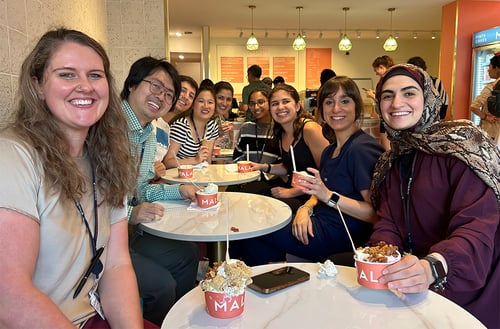
Our program is a community of residents and faculty that believes that the health and well-being of our profession is as important as that of the patients in our care: we cannot care for others unless we are well ourselves. We recognize that the wellbeing of each physician is a shared responsibility. The greater US medical system, the UPHS health system, the residency program itself and each of us as individuals contribute to our own wellbeing. Many of this residency program’s leadership are working at the national level to bring about much needed change. Effective interventions must address the system-level causes, including workflow inefficiencies, negative learning environments, and work overload with poor support. We also recognize that some of the norms of our profession - perfectionism, presenteeism, and pathologic altruism - also contribute to burnout. We strive as a community to reset these norms. At the program-level, our mission is to support each member of our community to thrive, not just survive, throughout residency. Lastly, we also acknowledge that each of us must make a commitment to our own individual health and well-being: physically, emotionally and spiritually.
What wellness looks like at Penn IM
As a residency program, we believe that we are stronger as a community than any of us working alone. This team-centered philosophy permeates our inpatient services, our outpatient clinic sites, and how we approach the wellbeing of our resident community.
Integrated into the residency’s academic curriculum is a longitudinal Emotional Intelligence (EQ) curriculum, co-directed by Dr. Oana Tomescu and Dr. Farah Hussain. This evidence-based curriculum incorporates a diverse array of strategies from multiple disciplines that have been shown to help trainees develop a personalized EQ toolkit to use for their own personal development and to better care for their patients. The EQ curriculum continues into JAR and SAR years, with a focus on using these strategies to become more effective team leaders.
Our program financially supports many social activities, including social groups (Book Club, sports teams, and many more), team brunch and insomnia cookies for our residents on night float, ILM group social functions, and other team-based events. The program hosts a holiday party annually and sponsors several dinners for the SAR class throughout the year.
We are committed to supporting our residents in all these ways. Wellness is about community, safety, belonging and support.
Wellness spaces
We know that our environments contribute greatly to our well-being. Our program is committed to creating sanctuary spaces in which our residents can relax, recharge with a healthy snack or coffee/tea, and just pause to take a break in the middle of a workday.
Our program is also committed to workspace redesign: most recently, we renovated the Medical Education Office, providing additional learning and touchdown space.
We use outdoor space for socializing as much as possible.
The recently renovated Housestaff Gym can be used by all trainees at HUP.
HUP wellness rooms in the Pavilion
There are also a variety of wellness rooms located on inpatient floors in the pavilion that are available for all HUP employees. There are spaces with exercise equipment, wellness coaching, meditation space, etc. These spaces can be reserved for your use!