
Inpatient rotations
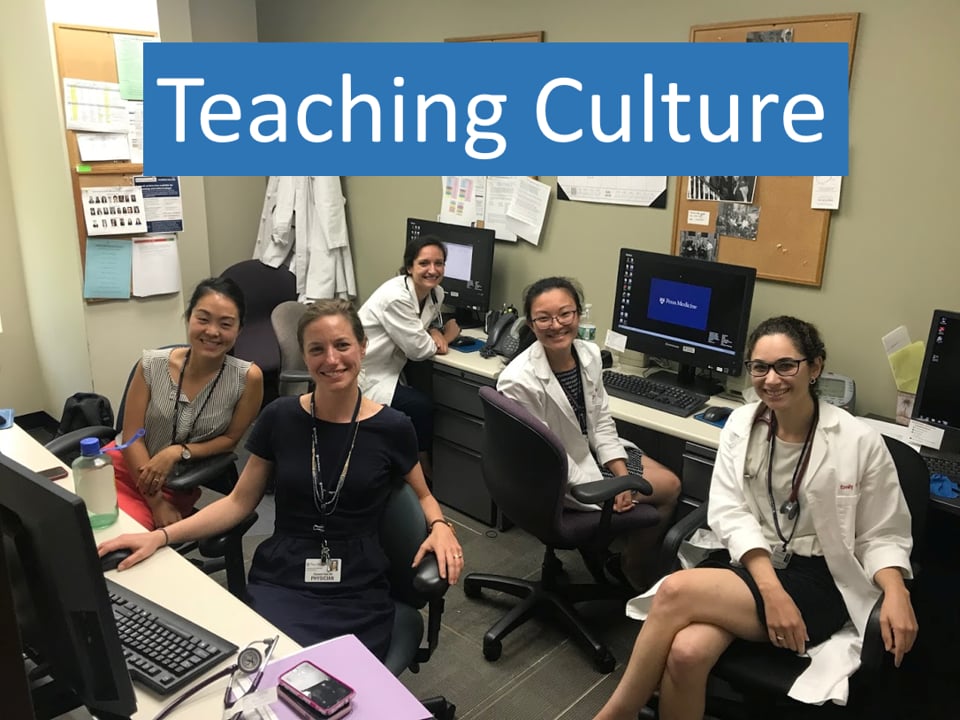
Our inpatient teams are comprised people from many different disciplines including of faculty, residents, medical students, pharmacists, social workers, respiratory therapists and many others. Our culture emphasizes team-based care and academic rigor. Our residents play important roles in teaching and mentoring medical students on their inpatient rotations.
Our residents rotate through a wide variety of inpatient rotations that offer them an opportunity to work with master clinicians and specialty experts at 3 inpatient hospitals: Hospital of the University of Pennsylvania (HUP), Penn Presbyterian Medical Center, and the Philadelphia VA Medical Center (all walking distance from each other). We are honored to care for a diverse patient population.
Our inpatient teams are comprised people from many different disciplines including of faculty, residents, medical students, pharmacists, social workers, respiratory therapists and many others. Our culture emphasizes team-based care and academic rigor. Our residents play important roles in teaching and mentoring medical students on their inpatient rotations.
We are also excited about the Penn Pavilion. This innovative hospital houses 500 private patient rooms and 47 operating rooms in a 1.5 million square foot, 17-story facility across from the Hospital of University of Pennsylvania and adjacent to the Perelman Center for Advanced Medicine.
Rotation specifics
Cardiology:
Residents rotate through the Cardiac Intensive Care Units at HUP (the Cardiac Intensive Care unit). Many patients are part of the advanced heart failure and mechanical circulatory support program that coordinates with the heart transplant program.
Inpatient general medicine:
Residents and interns participate in general medicine rotations at each of our three hospital sites, sharing the common themes of a generalist service but with distinct flavors at each site. The general medicine rotations all offer excellent opportunities for teaching core clerkship students. At HUP, the Martin teaching service (named for a former program director) cares for a broad range of patients with undifferentiated presentations under the direction of our academic hospitalist group. These patients include some patients followed by HUP specialists who are admitted for unrelated concerns, and may therefore have some more unusual diagnoses along with their active concerns. At Penn Presbyterian, the general medicine teams serve our local West Philadelphia community. Patients typically have a variety of common general medicine diagnoses, and many attendings are from our academic outpatient practices. At the VA, the general medicine services have a focus on intensive teaching, and the VA is the main home of the medicine sub-internship. We are happy to serve the veteran community from the wider Delaware Valley including those needing subspecialty care.
In addition to general medicine rotations, our residents rotate through the Acute Care of the Elderly (ACE) unit at Penn Presbyterian where they focus on caring for an inpatient geriatric population. There is a strong emphasis on interdisciplinary team management and care as part of a caregiver team on the Acute Care for the Elderly unit.
Oncology:
Residents have oncology rotations at HUP where patients are divided into teams focused on Liquid malignancies. Residents care for patients who receive cutting edge care for all types of hematologic cancers including leukemias, myelodysplastic syndromes, lymphomas, and plasma cell dyscrasias. Supervising attendings are frequently leaders of translational research initiatives that constantly advance the therapeutic options for our patients.
Hepatology:
Residents have the opportunity to rotate on the Hepatology inpatient service, primarily focused on treating patients with cirrhosis, medical complications from prior liver transplantations, and other liver diseases.
Infectious diseases:
The Infectious Diseases (ID) service is staffed by our world-class expert attending in ID and primarily care for patients with HIV. Residents on this service also get to provide care for patients withour HIV who are being admitted for other ID diagnoses inclduing endocarditis, endemic mycoses, any parasitic infections, epidural abscesses, tuberculosis, fever in a returning traveler, and fevers of unknown origin.
Pulmonary:
This service takes care of patients with obstructive airway diseases, interstitial or cystic lung diseases, non-cystic fibrosis bronchiectasis, pneumothoraxes, pulmonary hypertension, and cute on chronic hypoxemic or hypercarbic respiratory failure due to neuromuscular diseases.
MICU:
The Medical Intensive Care Unit at HUP is the main site for critical care. This rotation has been our most highly rated for most of the past two decades, and is staffed by pulmonary and critical care attendings who have won many of our most prestigious teaching awards. The MICU often cares for patients receiving other advanced care (solid organ transplantation, cancer chemotherapy or immunotherapy), and features complex multidisciplinary care provided alongside fantastic nurses, clinical pharmacists, and other colleagues.
Jeopardy:
The program is fully committed to providing prompt coverage for residents who are sick or who have urgent personal or family needs. There are residents assigned as the primary full-time ‘jeopardy’ residents, able to cover for the majority of unanticipated needs. A small fraction (about 1/5) of residents on elective are also designated for “jeopardy” coverage for one of their two weeks on elective. These residents carry on with normally scheduled elective activities unless needed for urgent coverage.
Outpatient rotations
Experience in outpatient medicine is an important component of our training program. Each trainee has a continuity practice experience in which they serve as the primary care physician for a panel of patients. They provide chronic, acute, and transitions of care for these patients. Strong relationships are forged and residents learn critical ambulatory medicine skills. Outpatient training takes place during the ambulatory (“+2”) blocks.
Ambulatory training
Experience in outpatient medicine is an important component of our training program. Each trainee has a continuity practice experience in which they serve as the primary care physician for a panel of patients. They provide comprehensive care for their patients, including preventive care, chronic disease management, acute care, and transitional care following hospital discharge. Strong relationships are forged and residents learn critical ambulatory medicine skills. Outpatient training takes place during the ambulatory (“+2”) blocks.
We have three categorical ambulatory clinical sites:
- 3701 Market Street, 6th Floor – Edward S. Cooper Clinic
- 3701 Market Street, 7th Floor – Penn Internal Medicine University City
- Corporal Michael J Crescenz VA Medical Center
All of our clinical sites are blended faculty / resident practices. Our residents are fully integrated partners in practice, and the blended clinic model ensures a well-functioning clinic with strong staff support. Our practices have:
- Medical Assistants, Patient Service Associates, Clinic Coordinators
- Registered Nurses, Licensed Practical Nurses
- Nurse Practitioners
- Social Workers
- Clinical Pharmacists
- Embedded Behavioral Health Providers
We have a diverse patient population drawn primarily from the surrounding West Philadelphia community. Approximately 25% of our patients have Medicaid and 40% have Medicare. Our resident-centered continuity is about 60%, meaning that most of the time, our residents are seeing their own patients, with the other visits composed primarily of acute (sick) visits and hospital discharge visits for patients of other residents and attendings in the practice.
In addition to practicing together, faculty and residents work together to create an ongoing series of weekly conferences based on cases, a curricular framework, and the most recent medical literature. Ambulatory Report takes place daily at lunchtime and provides a robust curriculum led by faculty and residents.
With regard to outpatient clinical mentorship, each resident develops a longitudinal relationship with a faculty preceptor who provides feedback and mentorship over the three years of ambulatory training.
Ambulatory education leadership
- Patrick Sayre - Associate Program Director
- Lauren Mechanic – Educational Co-Lead for PIMUC
- Brad Fetzer – Educational Lead for Corporal Michael K Crescenz VA Medical Center
- D. Rani Nandiwada – Program Director for the Primary Care Residency Program
Average breakdown of rotations
| Rotation | PGY1 | PGY2 | PGY3 |
|---|---|---|---|
| Ward-Gen Med/Specialty | 18 weeks | 12 weeks | 12 weeks |
| Cardiology | 3 weeks | 5 weeks | 2 weeks |
| Oncology | 3 weeks | 2 weeks | 2 weeks |
| MICU | 4 weeks | 4 weeks | 4 weeks |
| Emergency Medicine | 2 weeks | 0 weeks | |
| Ambulatory or Elective | 16 weeks | 22 weeks | |
| Service Block/Jeopardy | 2 weeks | 2 weeks | 2 weeks |
| Vacation | 4 weeks | 4 weeks | 4 weeks |
Outpatient practices
Edward S. Cooper Practice
The Edward S. Cooper Clinic located at 3701 Market St, 6th floor, was founded in 2003 by Edward S. Cooper, the first black president of the American Heart Association and longstanding distinguished faculty member of the University of Pennsylvania. The clinic was founded with the core mission to serve the surrounding West Philadelphia Community. Home to over 10,000 patients, this blended practice includes both faculty & resident providers, who work closely to care for patients. Providers work alongside a large staff to care for patients, including registered nurses, an on-site social worker, an on-site licensed clinical social worker who provides mental health support to patients, pharmacists, community health workers, and many others.
Penn Internal Medicine University City
Penn Internal Medicine University City (PIMUC) has its roots as one of the oldest Primary Care Practices at the University of Pennsylvania. It is located at 3701 Market Street on the 7th floor and cares for a diverse patient population including patients from West Philadelphia and the University Community. It is a blended practice: both attendings and residents caring for their patients at the same site. PIMUC is also proud to embrace a strong interdisciplinary approach to care that includes nurse practitioners, licensed clinical social workers, pharmacists, community health workers, and many other important members of the team. Our attending physicians range in experience from recent graduates of our program to seasoned master clinicians.
Philadelphia VA Medical Center
The Cpl. Michael J. Crescenz VA Medical center in Philadelphia is one of the nation’s largest VA centers and is the regional referral center for all VA hospitals in Eastern Pennsylvania, providing care for over 50,000 Veterans. The resident ambulatory practice plays a significant role in caring for these veterans and sees a diverse array of medical issues and Veteran specific issues, stretching over numerous eras of military service. Providers practice in an interdisciplinary setting alongside a robust behavioral health practice as well as pharmacy, social work and pain management. The clinic has a diverse group of preceptors and an experienced patient care team to support the practice.
Penn Center For Primary Care
The Penn Center for Primary Care is the home base of the Primary Care Residency Program. See a full description of the Primary Care Program.