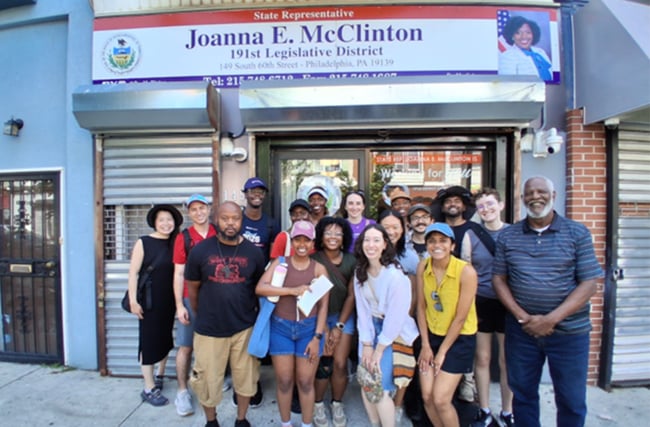
Community health training at Penn Family Medicine
At Penn Family Medicine, we believe exceptional physicians must understand not only disease, but also the communities in which their patients live, work, learn, and seek support. Our Community Health Training curriculum prepares residents to become skilled clinicians, effective advocates, and collaborative partners in advancing health equity throughout West Philadelphia and beyond.
Our training is grounded in the belief that health is shaped by historical, social, environmental, and structural factors. Through longitudinal community engagement, experiential learning, and partnerships with local organizations, residents develop the knowledge and skills needed to address health disparities and improve community health outcomes.
Learning within the community
Community health training begins during orientation with the West Philadelphia Walk, led by community leaders who share their lived experiences and perspectives on the history, strengths, resources, and challenges of the neighborhoods our residents serve. This experience helps residents develop cultural humility and gain a deeper understanding of the social and structural determinants of health affecting their patients.
Residents continue this learning throughout residency by engaging directly with community organizations, public health initiatives, schools, faith-based organizations, and local leaders working to improve health and well-being in West Philadelphia.
Community medicine track
At the completion of intern year, residents may elect to pursue the Community Medicine Track, one of our three core curricular pathways. This track provides enhanced opportunities for residents to partner with community organizations and engage in scholarship, advocacy, and care addressing social determinants of health.
Residents in the Community Medicine Track work closely with faculty mentors and community partners to develop projects that address community-identified priorities while building leadership skills in population health and community engagement.
Longitudinal health equity and advocacy curriculum
Community health education is integrated throughout all three years of residency through:
- Social justice and anti-racism curriculum
- Health equity and population health training
- Community-oriented primary care principles
- Advocacy skill development
- Training on structural racism and its impact on health
- Quality improvement initiatives focused on reducing disparities
- Community-engaged scholarly projects
Residents learn how to identify barriers to care, partner with patients and communities, and develop sustainable interventions that improve health outcomes.
Community partnerships
The Department of Family Medicine and Community Health has developed strong partnerships with organizations in urban Philadelphia Neighborhoods.
Our residents learn alongside patients and community partners throughout West Philadelphia, from providing care at West Philadelphia High School to delivering prenatal services at Federally Qualified Health Centers throughout the city.
Through longstanding partnerships with community-based free clinics such as Puentes de Salud, African Family Health Organization (AFAHO) and the United Community Clinic (UCC), residents learn firsthand how community engagement, interdisciplinary collaboration, and service can improve health outcomes and reduce barriers to care for historically underserved populations.
Residents collaborate with interdisciplinary teams, community organizations, and public health partners to:
- Address social needs affecting patient health
- Improve preventive care and chronic disease management
- Develop community-informed interventions
- Support maternal and child health initiatives
- Advance health equity through systems-level change